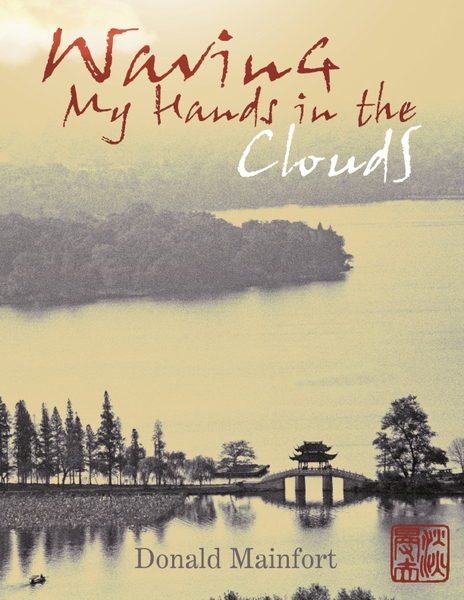
Waving My Hands in the Clouds: A Memoir of 1990s China
Waving My Hands in the Clouds is a documentary-style memoir based on my years living and teaching in China during the 1990s. Begun in 1999 and substantially completed by 2005, the manuscript remained unpublished for two decades before finally appearing in print in 2025. It spans 658 pages and includes 182 photographs taken during the period, together with footnotes and other supporting documentation.
Although sometimes described as a travel memoir, the book is equally a personal history, an eyewitness account, and a documentary record. It follows my experiences from my first visit to China in 1992 through several years of teaching at Chinese universities during a period of rapid economic, political, and social change.
Rather than centering on a single theme, the narrative develops chronologically. Daily life—housing, travel, friendships, martial arts, university routines, and family relationships—gradually gives way to larger events that I encountered firsthand, including the turbulent transition to a market economy, devastating floods, the institutional promotion of qigong, the rise and suppression of Falun Gong, skeptical investigations into paranormal claims, and the atmosphere surrounding the 1999 Belgrade embassy bombing. Those events are presented as they were experienced at the time, not reconstructed to fit a later historical interpretation.
The photographs are intended as documentation rather than illustration, preserving people, places, and events that form part of the narrative. Throughout, the emphasis remains on observation rather than argument. My purpose was not to write a history of modern China or an academic study, but to leave an accurate record of what I saw and experienced while living there.
The title comes from the taijiquan movement Waving Hands in the Clouds. Beyond its martial arts origin, the phrase came to symbolize my own experience of navigating Chinese society: making contact, adapting to unfamiliar circumstances, and finding a path through layers of bureaucracy, belief, and cultural complexity. I spend 658 pages trying to wave the clouds away so the reader can see what was actually there.
I realized from the beginning that this would never be a conventional commercial book. Its subject matter ranges across memoir, travel, university life, martial arts, skepticism, photography, politics, and family history without attempting to separate them into distinct narratives. Life itself is not organized that way. My objective was simply to preserve one person's sustained experience of China during a remarkable decade, in the hope that future readers might find value in seeing that period through the eyes of someone who lived it.
Product Options
Waving My Hands In The Clouds